
Turn accessibility from afterthought to architecture.
14ten is a durable foundation for Deaf accessibility — a repeatable way to interpret and operationalize 47 CFR Part 14 with verifiable signals, deterministic rules, and defensible records.
Today’s accessibility landscape sits on an unstable foundation.
Compliance is often ad hoc, inconsistent, and hard to audit — precisely as systems become more AI-mediated and more complex.
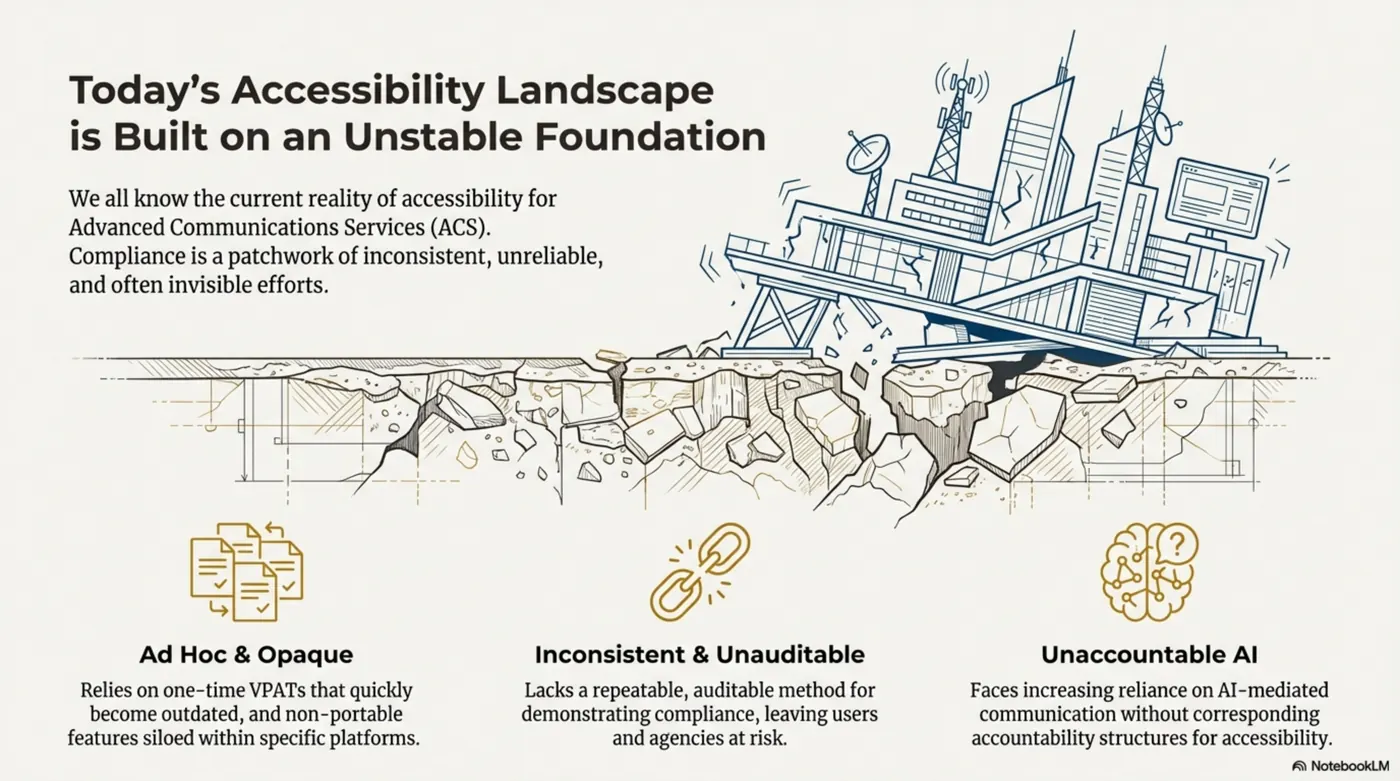
Key idea: The challenge isn’t the absence of law — it’s the absence of a framework to implement and verify it consistently.
14ten is that missing “how.”
The mandate already exists: 47 CFR Part 14.
The rules for accessible Advanced Communications Services are clear. What’s missing is a consistent, repeatable method for meeting them — and proving it.
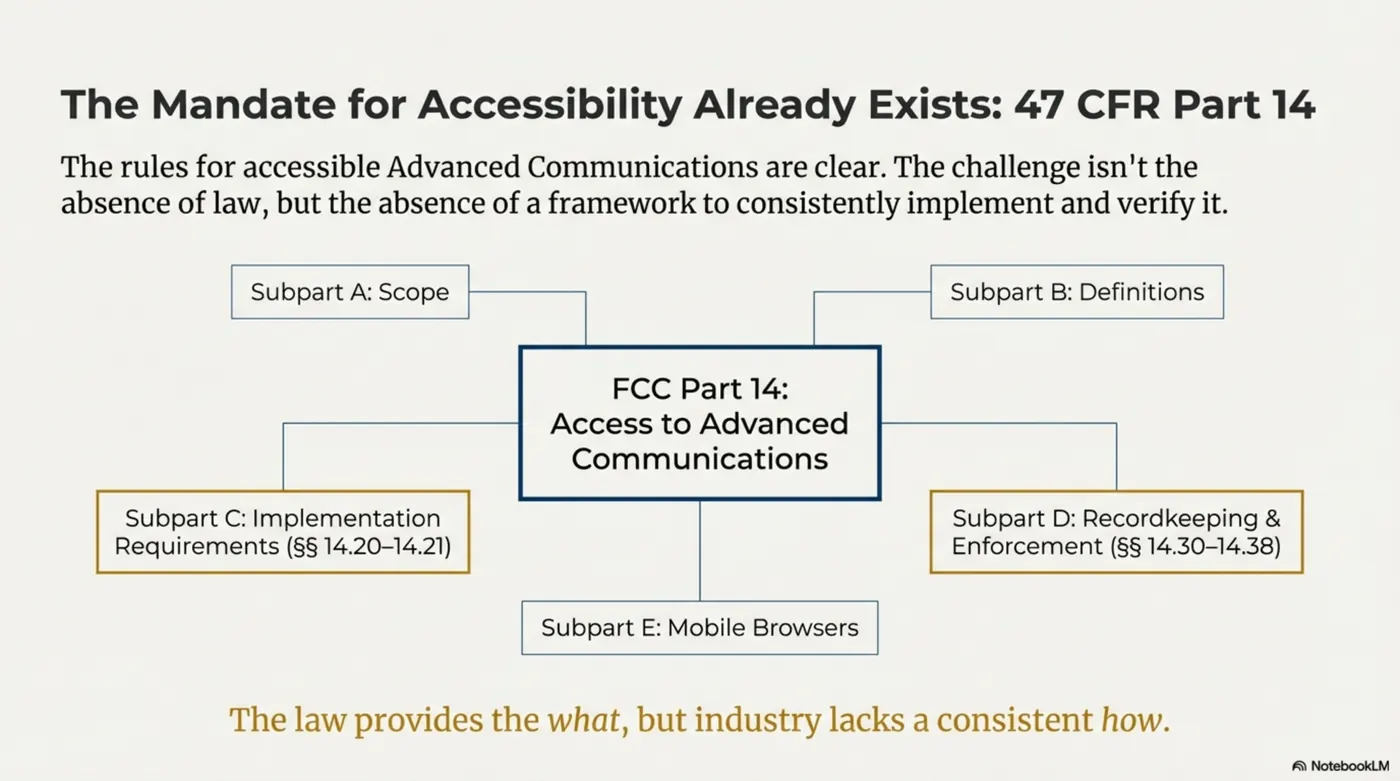
The law provides the what. Industry lacks a consistent how.
14ten translates obligations into operational structure: events, rules, routing, and records.
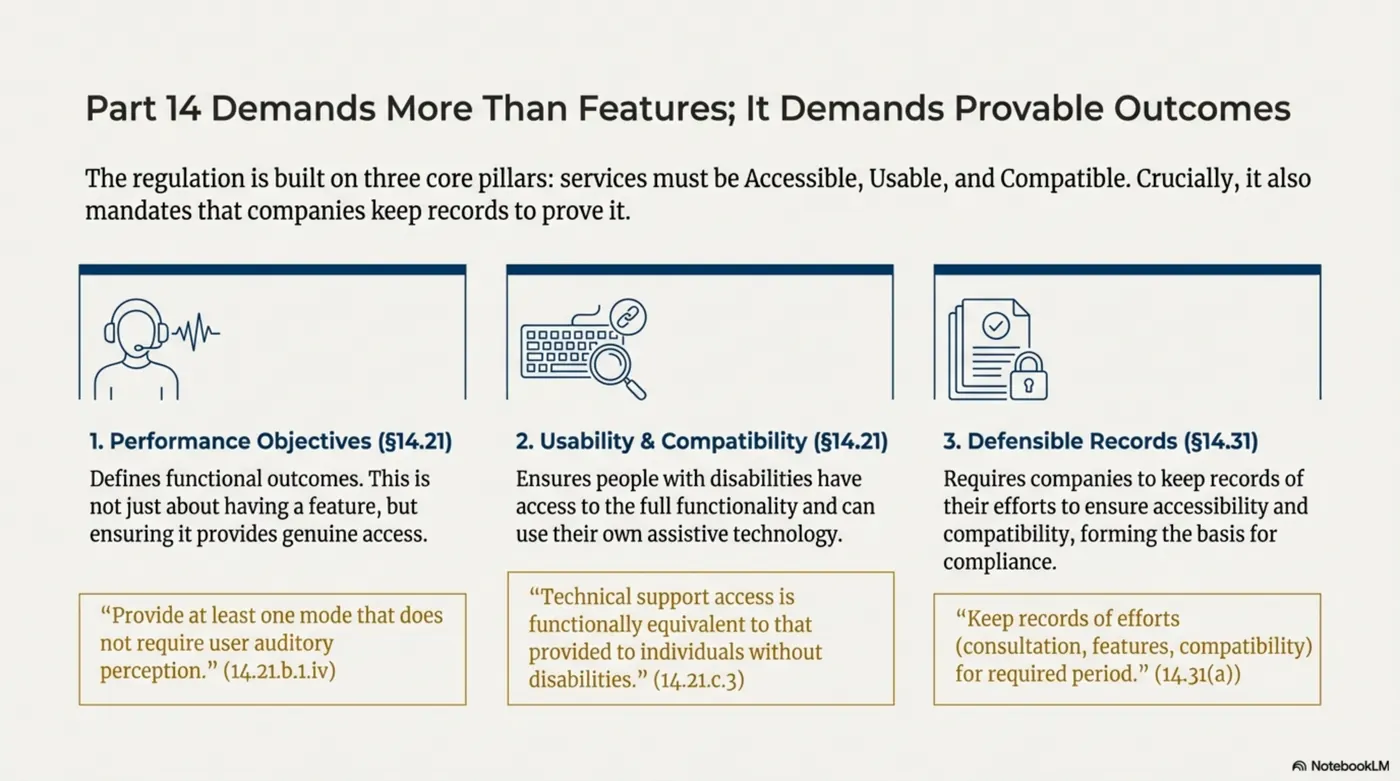
Part 14 demands more than features. It demands provable outcomes.
Accessibility has to work in practice — and companies must keep defensible records to prove it.
What changes with 14ten
- Claims become data: discrete, immutable signals.
- Decisions become logic: deterministic rules with traceability.
- Compliance becomes output: evidence and assertions produced by the system.
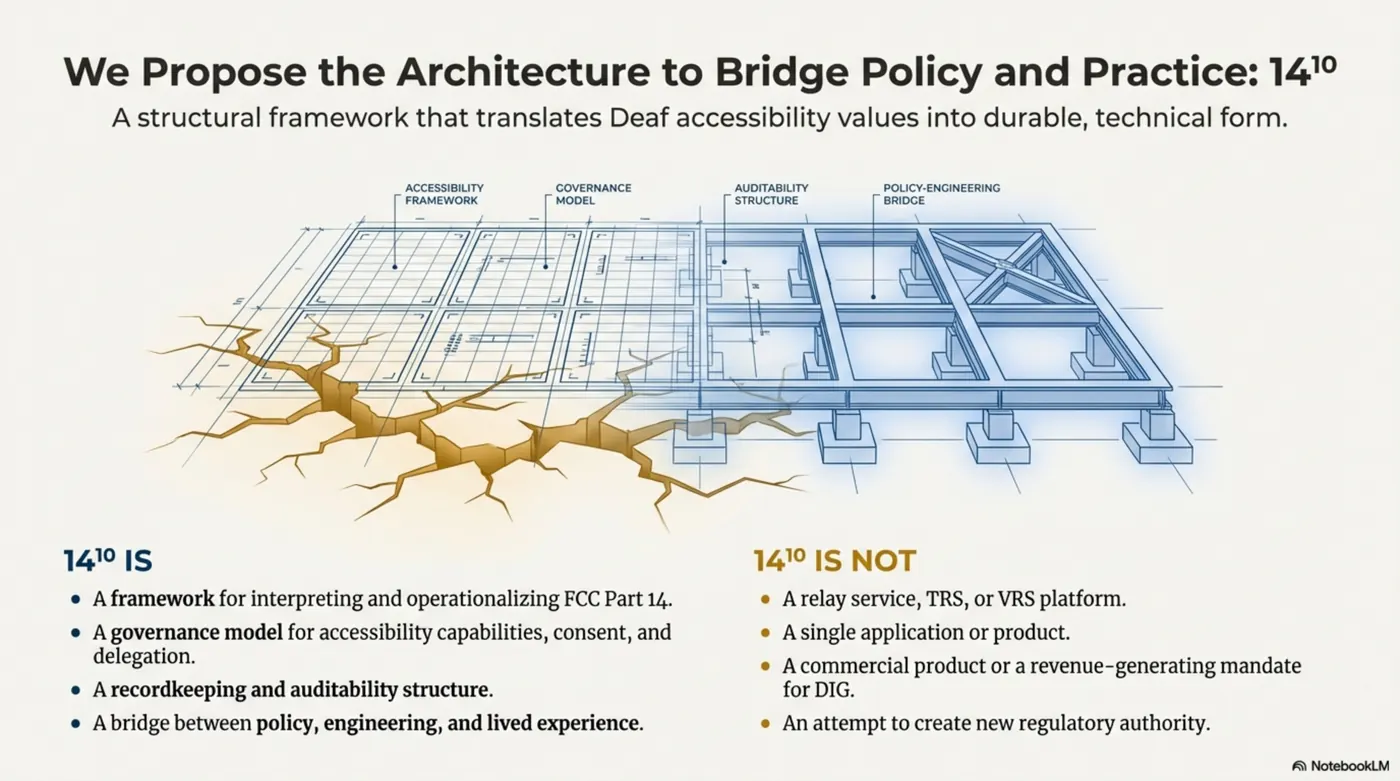
An architecture to bridge policy and practice.
A structural framework that translates Deaf accessibility values into durable, technical form.
14ten is
- A framework for interpreting and operationalizing FCC Part 14.
- A governance model for capabilities, consent, and delegation.
- A recordkeeping and auditability structure.
- A bridge between policy, engineering, and lived experience.
14ten is not
- A relay service, TRS, or VRS platform.
- A single application or product.
- A vendor endorsement or certification program.
- New regulatory authority.
Ten dimensions of modern communication.
Part 14 obligations don’t exist in a vacuum. They must apply simultaneously across the realities of modern systems. 14ten provides the structure to evaluate that reality.
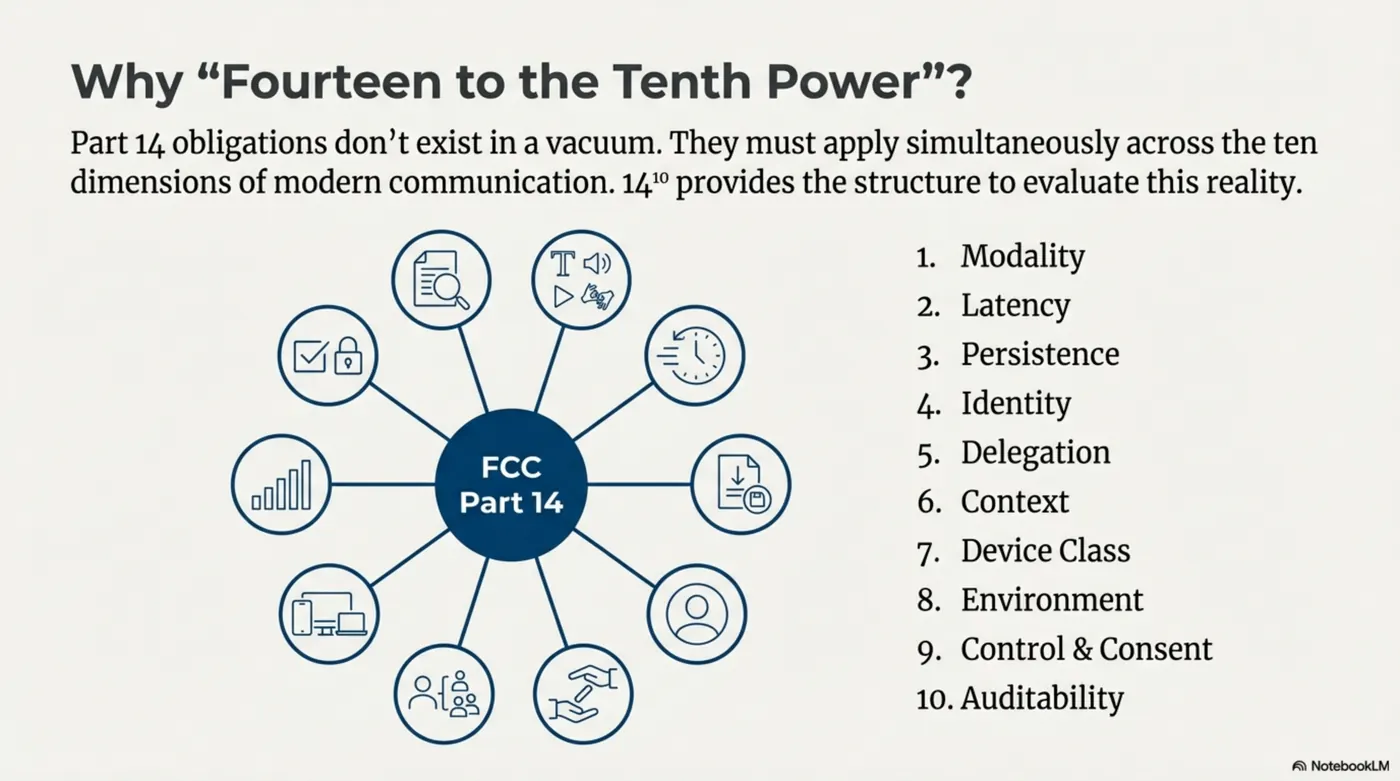
In practice: a single “caption feature” is not enough. You have to reason about timing, device class, environment, consent, and auditability — together.
A common language for accessibility events.
14ten creates discrete, immutable, verifiable pieces of information — transforming vague claims into concrete data.
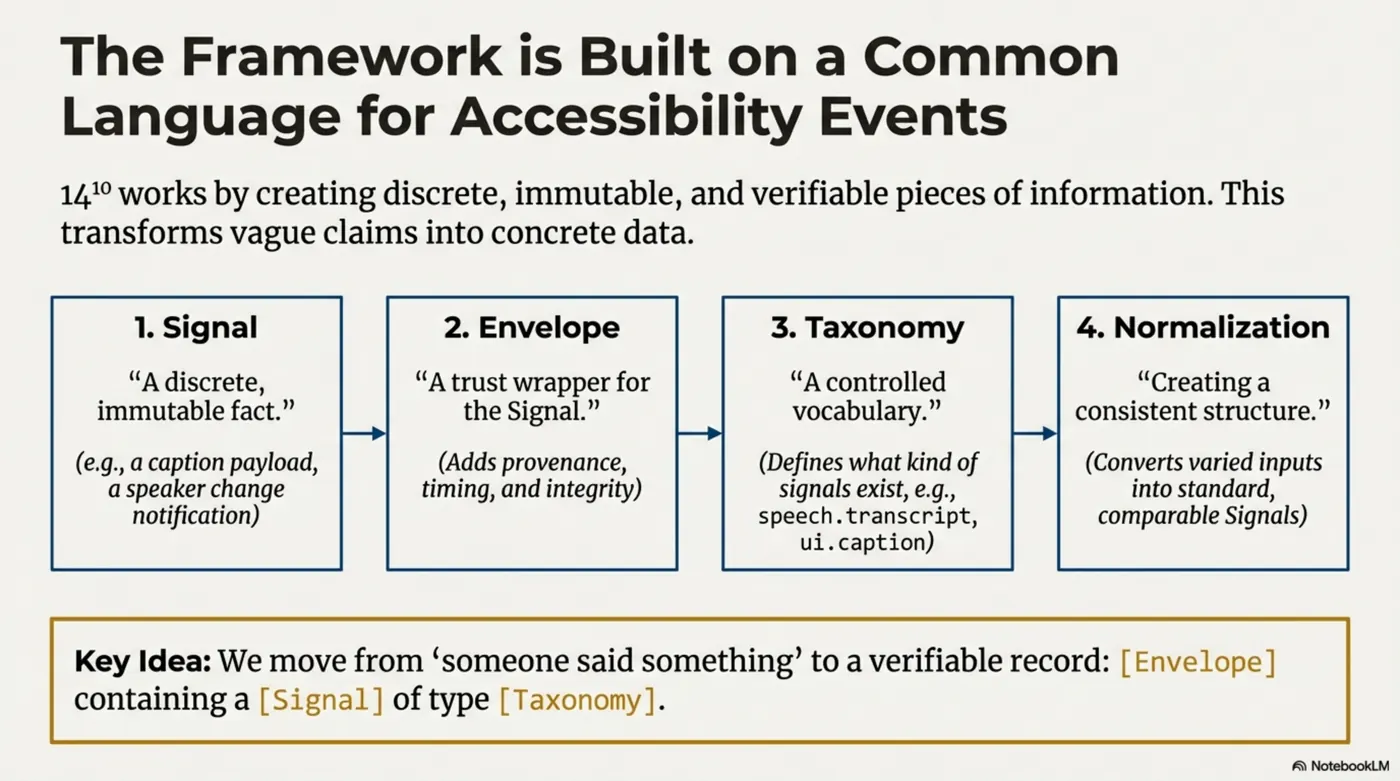
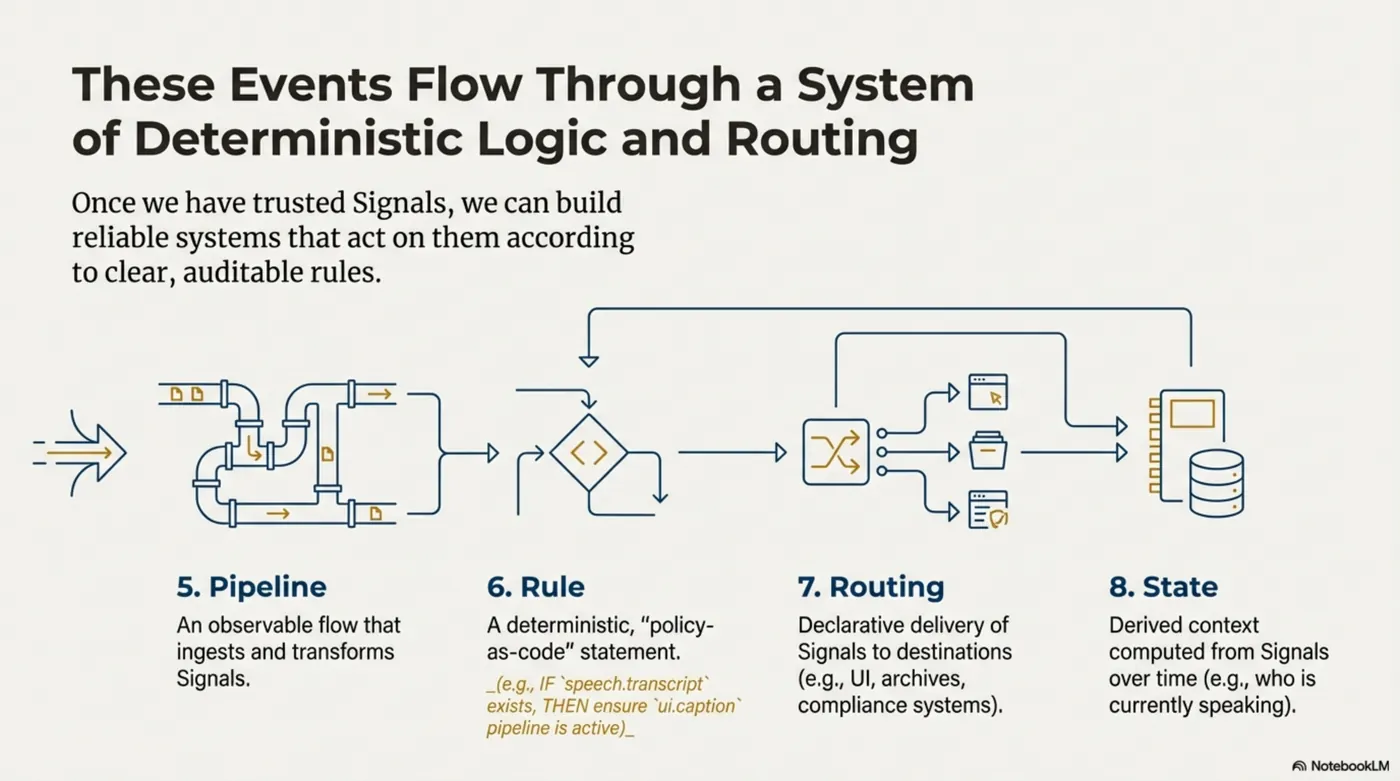
Key idea: Move from “someone said something” to a verifiable record: an Envelope containing a Signal of a defined Taxonomy.
Evidence and assertions that directly address Part 14.
The system produces two critical outputs aligned to recordkeeping obligations: persisted evidence and audit-ready assertions derived from that evidence.
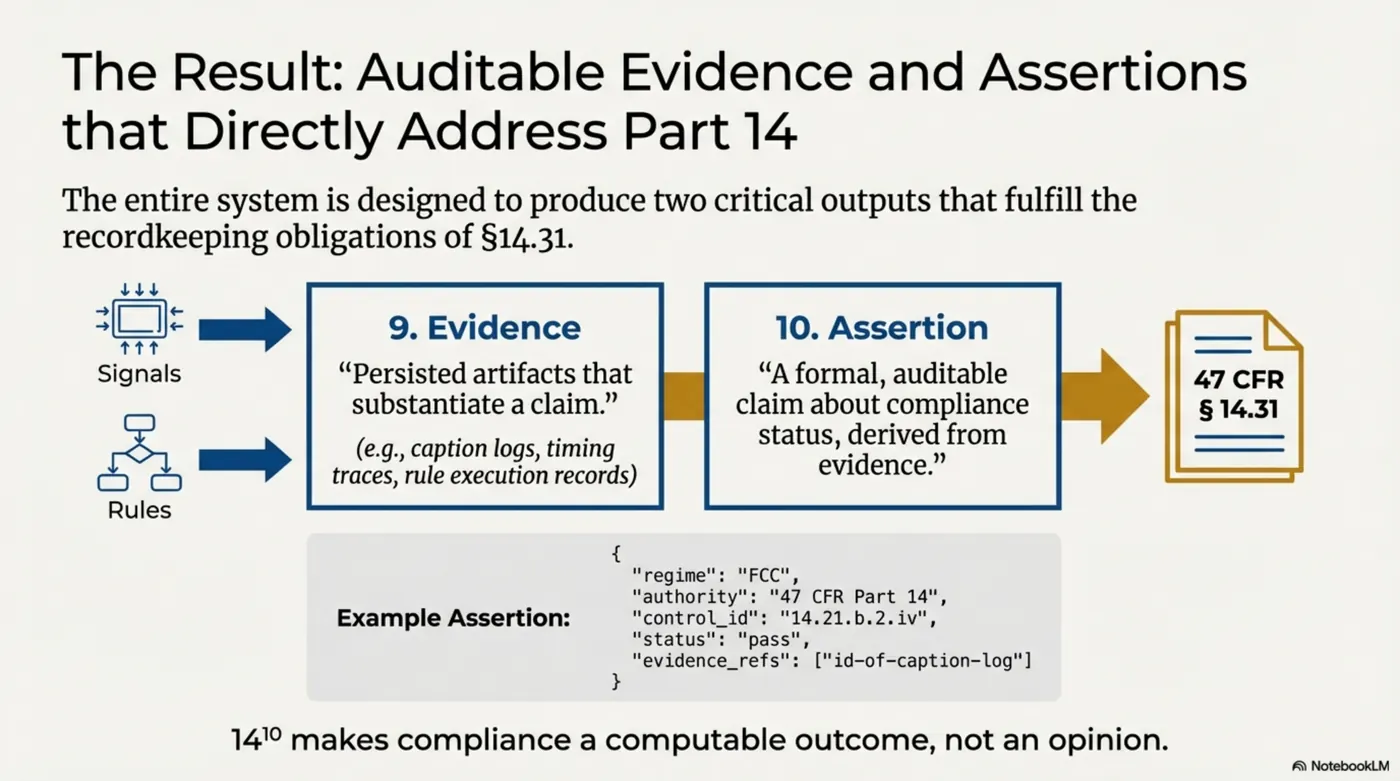
Bottom line: 14ten makes compliance a computable outcome — not an opinion.
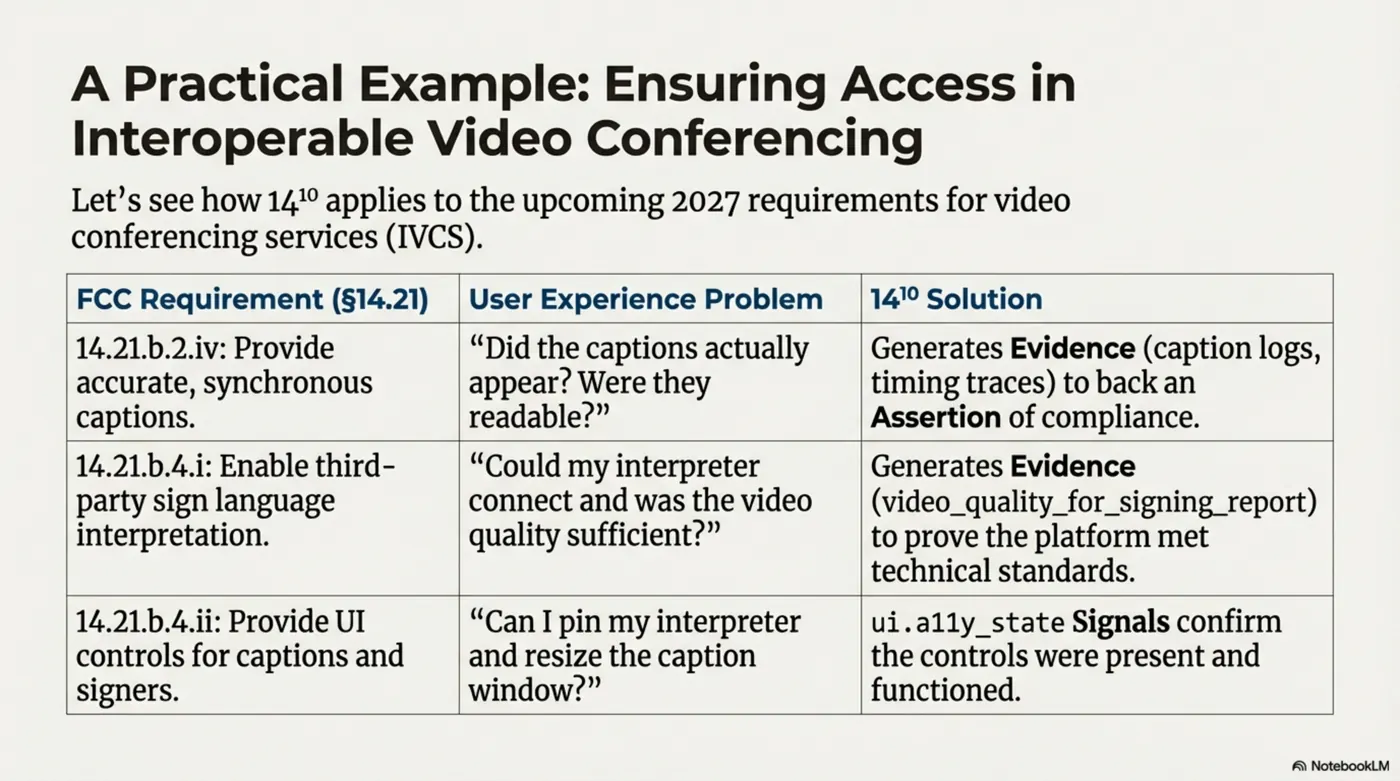
A practical application: ensuring access in interoperable video conferencing.
14ten can translate upcoming IVCS requirements into observable signals, evidence logs, and assertions of compliance.
Pattern
- Translate obligation into signals.
- Instrument systems to produce evidence.
- Generate assertions that are inspectable.
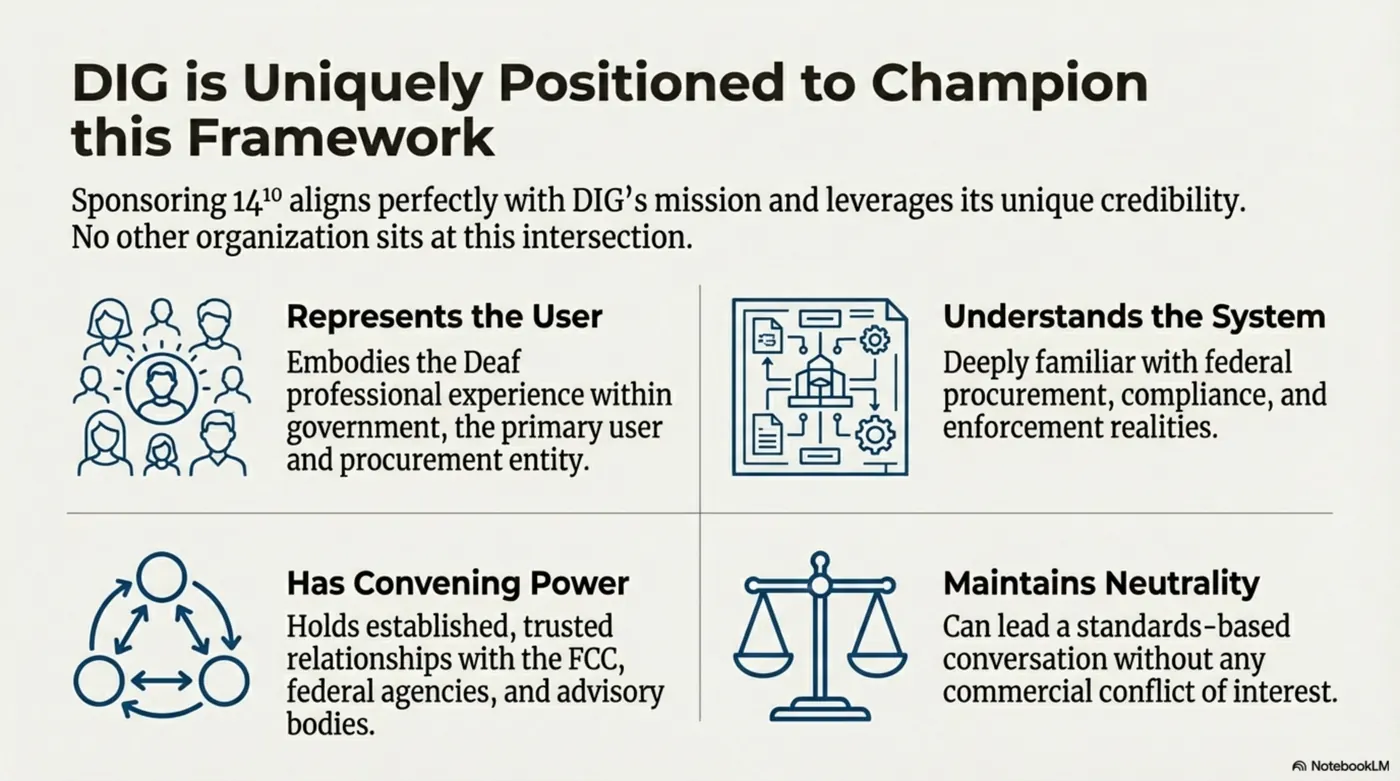
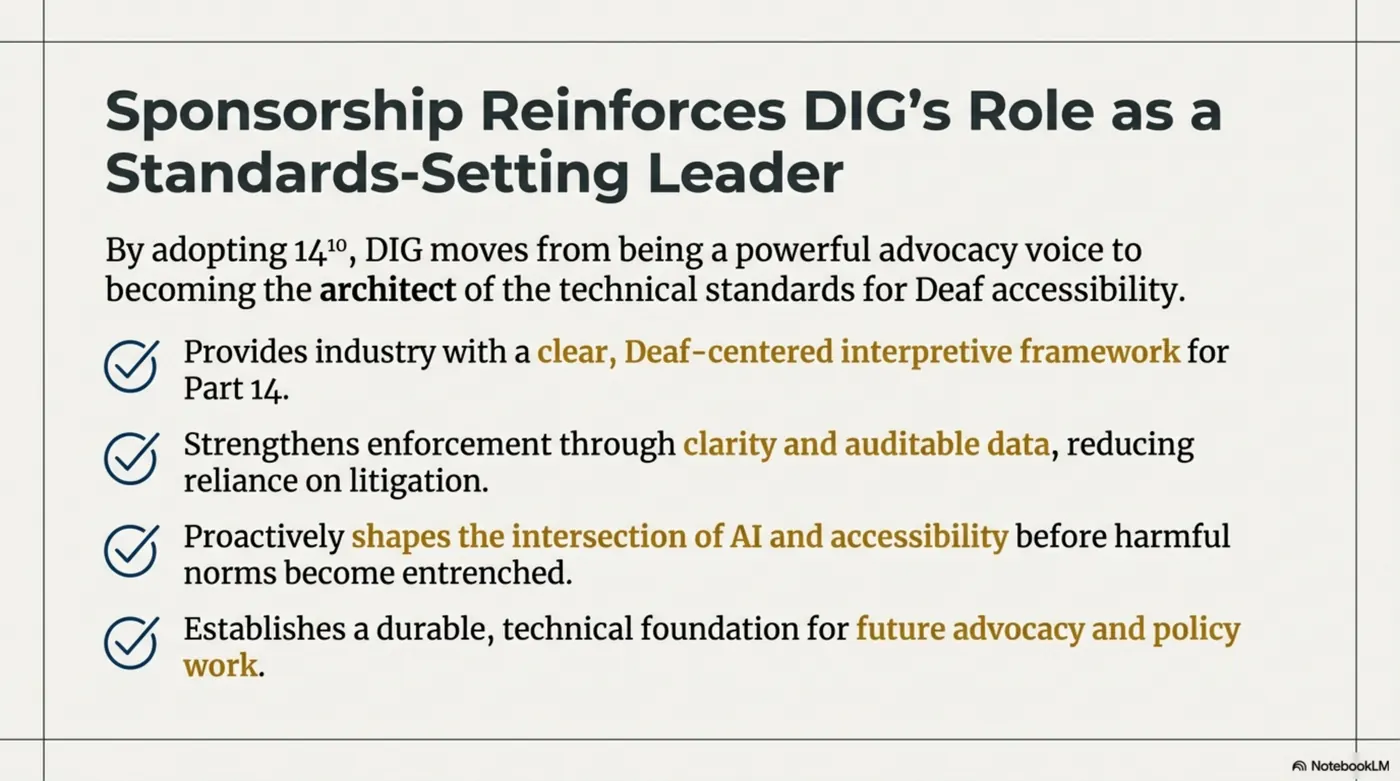
DIG is uniquely positioned to champion this framework.
Sponsoring 14ten aligns with DIG’s mission and leverages its credibility — representing the user, understanding the system, convening stakeholders, and maintaining neutrality.
A Salesforce-native adoption path is straightforward.
14ten’s primitives map cleanly to the Salesforce language: objects, rules, and dashboards — with evidence trails that regulated buyers already expect.
Objects: Signal, Envelope, Evidence, Assertion — each first-class, queryable, and reportable.
Rules: deterministic logic (Flow/Apex) to compute state and generate assertions with traceability.
Dashboards: posture, coverage gaps, and incident review — all backed by defensible records.
Why this appeals to enterprise buyers
- Governance-ready: aligns with how compliance teams work.
- Composable: starts with one workflow, expands across products.
- Trust-first: evidence + assertions become reusable infrastructure.
The choice before us
This is not about moving fast. It is about getting the foundation right — once — so access is never again an afterthought.
If you’re evaluating this as an investor
- Standards-first: creates a repeatable, auditable interface between policy and systems.
- Enterprise-shaped: deterministic logic, evidence trails, and governance primitives align with regulated buyers.
- AI-ready: accountability structures for AI-mediated communication.